
THE CONFESSION:
“I knew we’d both have to make financial sacrifices to do this… but I didn’t realise we had totally different ideas of what that actually meant.
One of us feels fine keeping salary low to invest in the business long-term. The other needs a certain level of income to feel stable and not stressed. Neither of us is wrong, we just never aligned on it.
Now there’s this quiet tension around money, and we don’t really know how to talk about it without it getting heated.”

Money is one of the biggest triggers between co-founders - not because you're doing anything wrong, but because money is emotional. For all of us.
And when you throw in the unpredictability of a startup, the lack of a steady income, and the fact that this money is tied to something you’re building (your identity, purpose, sense of worth) … it’s a whole different kinda complex.
You can’t fully anticipate what any of that will feel like until you’re in it. So I’m curious - did you define what “financial sacrifice” meant? Not just conceptually, but practically?
Did you talk about numbers?
About how long each of you could go without a certain salary?
About what each of you needs to feel stable, and not stressed?
And about the timeline for this sacrifice - aka, how long is “long-term investment”?
Those aren’t easy conversations, but without that shared understanding, tension can build. And beyond the numbers, there’s a deep emotional layer.
Before becoming a co-founder myself, I had never really experience financial unpredictability. I never had to confront my beliefs about money, my fears about not having it, or what money symbolised for me. But running a business with a co-founder very quickly shone a bright light on my money patterns and beliefs, and it made me confront questions I’d never had to before like:
How much money do I actually want?
Why do I want it?
What does “success” mean to me, beyond numbers?
What does money symbolise to me?
What’s my perception of ‘fair’ in terms of compensation? (That’s a big one)
So when both of you are uncovering all of that, AND putting it into the mix of the partnership… that’s a lot to navigate. And this is why trying to solve money tension just through spreadsheets and logic often doesn’t work. Because usually, beneath the surface, there are deeper layers like: “Money proves I’m enough. Money protects me. Money validates the choices I’ve made.” [Insert whatever your version of that inner story looks like.]
So you start with conversations not about the business, but about each of you as people. Questions like:
What does money mean to me?
Why do I want it?
What am I afraid of financially?
How did money show up in my childhood? What beliefs did I pick up about money?
Only then does it make sense to move into the practical planning. From there, you can layer in business questions like:
How long can each of us go without a salary?
How much do we want to make?
When do we want to make it?
How will we compensate ourselves as roles evolve?
What’s our appetite for financial risk?
(And many more…)
These answers will continue to shift as the business and your personal lives evolve - so it’s important to have practical and emotional financial conversations regularly. Not just to avoid tension, but to build shared understanding and motivation for the financial blueprint you’re working off.
So if you can, see this tension as an opportunity. See it as a sign you’re uncovering important beliefs about money; and that you simply haven’t yet built the container to talk about it safely and constructively. And the good news is - you absolutely can. And when you do, it will unlock a new level of your partnership..
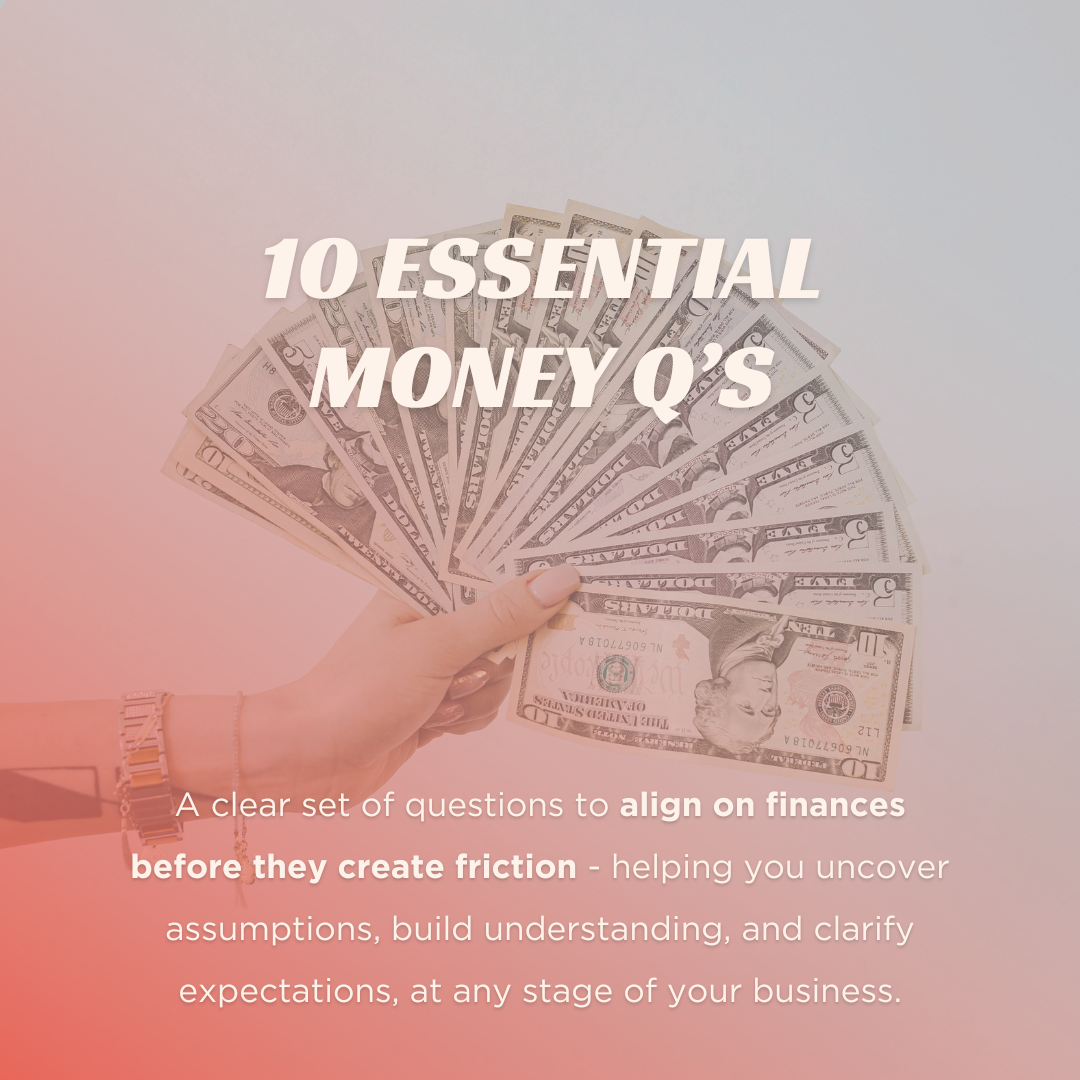
Check out my free workbook on money to help you!

A QUESTION FOR YOU ALL TO ASK YOUR CO-FOUNDERS:
“HOW ARE WE FEELING ABOUT MONEY - AND IS THERE ANYTHING THAT NEEDS TO BE VOICED?”
This edition was published on the 5th December 2025
